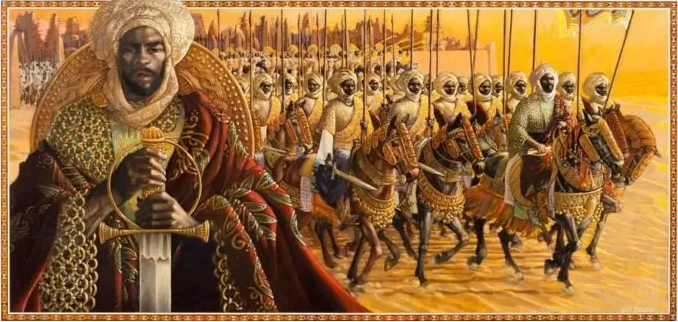
Islam has a golden history and Islamic Empires were the richest empires in the past. Muslims were living happily and Islam was dominating all across the world with the help of Allah and the guidance of Quran. But time doesn’t remain same. Muslims started ignoring the Quran and the Sunnah of Prophet Muhammad (Peace Be Upon Him) and Allah has given victory to Non Muslims over us. But let’s recall our glorious past and remember the time when Muslim Emperors were the richest people on the earth and Muslims were having peace and security under them.
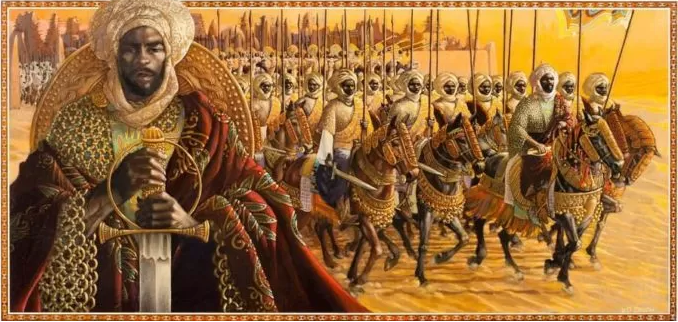
One such emperor was Mansa Musa, The King of Mali. He was born in 1280 in Keita dynasty. He was considered the richest man ever lived on this earth.
According to Rudolph Butch Ware, Associate Professor of History at University of California, “Contemporary accounts of Musa’s wealth is impossible to pen down to a number.”
According to TIME magazine, “There is really no way to put an accurate number on his wealth. His wealth is indescribable.” Mansa Musa was richer than anyone could describe.
As per Forbes Billionaire’s list 2019, Jeff Bezos, Founder of Amazon Inc. has net worth of $131 billion that makes him the wealthiest man in the current times. When compared with the wealth of Mansa Musa Bezos stands nowhere.
He ascended the throne after his elder brother abdicated it and went to explore the Atlantic ocean with 2000 ships full of man and never returned back.
So, according to the rule of land, he became the next emperor after his brother. Mansa was a fierce warrior. In his reign of 25 years, he conquered 24 cities, most of them were rich and prosperous at that time. One such city was Songhai capital of Gao on the Niger river, one of the oldest trading centre in Western Africa.
The source of indescribable wealth was abundance of gold in Mali. During his reign he was the man having more than half of the reserves of gold. Most of the cities conquered by him were based on the shore of Atlantic and were major trading centers of Africa.
Mansa Musa was a devoted Muslim. He devoted his time and wealth for the propagation of Islam in Western Africa. It is said that he used to construct a new mosque every Friday.
Because of his active involvement in propagation of Islam, he was very famous in North Africa and Middle East.
In the year 1324, he started his journey to Mecca accompanied with 60,000 men and 12,000 slaves along with soldiers, ministers and people from his court.
Even the slaves were wearing the silk clothes and golden jewelries. They took 80 camels each carrying 23 to 136 kg of gold dust. Mansa Musa distributed gold to the people he met on the way. He also traded gold in Cairo and Medina for souvenirs.
In July 1324, Mansa Musa visited Mamluk Sultan of Egypt Al Nasir Muhammad and signed various treaties related to trade and commerce and presented tons of gold to the Sultan.
His generous hand oust wrecked an entire country. During his 3 months stay in Cairo, he distributed gold to an extent that led to the deprecation in the price of gold. Sudden influx of gold devalued the metals for the next decade.
He went to Mecca not only for Hajj but to bring the direct descendants of Prophet (PBUH) and Islamic scholars to Mali for teaching Islam in Western Africa.
While he was returning from Mecca in 1325, he somehow managed to persuade many Islamic scholars and Qadis to accompany him to Mali.
He was not only a generous Muslim ruler but also a wise emperor. He built thousands of Madrasah, Mosques in Africa especially in Timbuktu and Gao city and facilitated the teaching of Islam for everyone easily. The most famous Sankore Madarsah (or University of Sankore) was built by him.
He turned the city of Timbuktu into an epicenter of Islamic education in Western Africa. When the news of the prosperity of Mali reached to the other part of world people from North Africa and Middle East started migrating to Mali to learn about Islam.
He died shortly afterwards, the reason of his death remains mystery till today. Later his kingdom was divided into several parts under the rule of his progeny. His next generation failed to maintain the legacy of Mansa Musa.

 alloutblog